Greetings From Behind the Podium

Guest essay by a recent college graduate

The author of this post wrote the following after reading a previous post of mine: Greetings from the Back Row.  He wanted to add the perspective from the other side of the room, so to speak.  This post is an honest reflection of this author's recent fraternity experience - hence its more personal feel in comparison with mine (and his wish to remain anonymous).  The author graduated last May. He became a founding father his freshman year, vice-president for two years, and president for one. He tries his best to remain involved with his colony (soon to be chapter) and his organization as a whole as much as he possibly can. -- John


I’m the brother you are going to miss.  I’m the go-getter.  The one that rallies the troops before a big event and makes sure that all of the t’s and i’s are crossed and dotted before it starts. I’m there to drive you home and I’m there to pick you back up when you fall.  When your parents come to town I’m the brother you introduce them to so that they keep the checks for dues coming and don’t feel like you are wasting their time and money.  I’m the first one to get to chapter meetings and the last one to leave.

I’m Mr. Involved.  I’m Fraternity Man of the Year.  Better yet, I’m Brother of the Year.

But let me tell you how I came to be this way.  I honestly had no intention of joining a fraternity.  When I walked the university’s involvement fair my freshman year I was lost in a sea of people that I didn’t know.  Granted, I played sports and was involved a lot in high school, but I was more of a “behind the scenes” kind of person.  I never wanted to step into the limelight.  I’ve always been very loyal and committed to anything that I do but never did things for the glory.  I walked past the fraternity’s table and saw a bunch of guys that would rather be someplace else, anywhere but stuck there having to talk to freshmen. I saw where I could make a difference. Make an impact.

I started off holding any position that I could.  Attending every event that I could.  Volunteering for whatever I could get my hands on.  Everyone, even my pledge class brothers, soon called me “super pledge."  Brothers showed me off to the sororities like a prize won at the fair and always let me slide whenever I messed up.  I soon found a liking for being involved and started running for committee chairs, and winning. Everyone liked me - or so I thought - because I brought a lot of passion to everything I did.  Most seemed to like my ideas, except those that felt their “fun” was in jeopardy.  But I ignored the critics because my intentions were good.  I wanted to make us better.  To make us The Best.

I worked my way up and ran for my first executive board position - and won.  I was eager to participate.  I actually felt like I was starting to matter and that people had respect for me; that people liked me.  I started to enjoy the limelight.  Other entities on campus took notice of me and asked me to get involved with them also and I did.  I figured it would make the fraternity look better in the end.  But then a series of things began to happen.

My grades started to slip.  I started to notice that I wasn’t “superman” and couldn’t do it all on my own.  I soon realized that I had nowhere to turn to and no one to ask for help.  I had taken on too much and was over-involved.  Everyone expected me to do it all.  To plan everything.  To make sure people follow the rules.  To keep in touch with everyone.  To do each person’s position for them.  It’s what I had done in the beginning so why should things change now?

The brothers started to doubt my intentions - and doubt me for that matter.  They began to question what I had in mind for the organization and my dedication.  I started to grow bitter. It was me who had worked behind the scenes while everyone else was out partying to make sure that our organization didn’t sink to the bottom.  I skipped social events so that I could catch up on schoolwork missed because of covering everyone else’s bases.  But no one noticed the fact that I was doing the work of many, just that I wasn’t in attendance at social events. They didn’t know what it felt like to be all alone when I was getting phone calls from administrators.  No one was standing next to me when I had to meet with the Greek Life advisor in the aftermath of whatever trouble some brothers caused, so that I could try to explain their actions, make excuses for them, and promise to handle it.

It doesn’t help matters that after reviewing manuals from our headquarters I realized that we were doing everything wrong.  Meetings were being run the wrong way.  Reports were done incorrectly.  To make matters worse our image on campus was atrocious.  No one respected us.  Our recruitment numbers declined.  Our GPA fell.  But when I started to make some changes, whether small or big, brothers started to take a stand against me.  There were things that we should have been doing all along but since I was going against our “traditions” brothers started to talk about me behind my back, fight the entire process, or worse, drop their membership.  Think of a hot plate pulled out of the dishwasher and put into cold water. Too much, too fast.

All I really wanted was for us to start doing things right.  The way that our founders and executive council members wanted us to.  You know, simple stuff like be respected on campus, follow our values, and live our ritual.

It doesn’t help matters that I would get emails, phone calls, or text messages from brothers filled with hatred because they didn’t like having to go in front of the judicial board.  Or were mad because I didn’t beg them to stay active as they threatened to leave.  Others started to lash out and tried to tear down everything I attempted to instill in our organization.  I started to feel more alone.  I started to question what I was doing this for.  I started to wonder why I was still involved or even still a brother in the first place.

All because of what?  Starting to hold them accountable?  Starting to expect them to live our ritual?  What happened to the days of “super pledge?”

Once my position’s tenure was over I disappeared.  I retreated back to being the behind the scenes guy.  And I found myself in the back row at meetings, whenever I did attend.  Even sitting behind the guys that disrupted them on purpose.  Younger and newer brothers wondered who I was at times.  My legacy was gone.  I found excuses and reasons to avoid going to any meetings or events.  I blamed it on being a senior and being busy.  I have been counting down the time until today, when I get to walk across this stage.  Some brothers have started to notice what I accomplished for the fraternity.  Others’ respect for me has started to recover after realizing all that I did.

Today, I’m not sitting with any of the brothers that are also graduating.  I’m sitting with the people I made friends with outside of the fraternity.  They don’t dislike me because I asked too much of them.  They can’t resent me for following or believing in a shared ritual.  They were there for me when my brothers couldn’t be.  Refused to be.  When I stood on homecoming court representing the fraternity at the big game, they were the ones that cheered me on when not a single brother was in sight.

The funny thing is, I joined a fraternity because I wanted to make friends.  You know, the kind where one day their kids call me “uncle” even though we don’t share a single gene.  The jury is still out on that one.

As a disclaimer, I’m not looking for you to feel sorry for me.  I brought it on myself.  I could have backed down and let them push me around.  Even resigned from the position.  But I don’t think that’s what our founders would have wanted, so I stuck with it.  If I didn’t believe in living the ritual then who was going to?  In fact, through all of the opposition that I faced, it made my love for the organization itself grow stronger.  Why else would I be wearing my organization’s graduation stoles today?

I just wanted you to see how things feel for someone like me, the one behind the podium.  I sacrificed a social life, time that I’ll never get back, and even my G.P.A.  I’m sure my family would love to hear Latin terms pronounced after my name today as I graduate, but hopefully they understand.  I’m just hoping and asking that you take it easy on the next “go-getter” coming up behind me.  To know what it felt like for me so he doesn’t have to go through what I did.

Maybe you can keep him from getting burned out.  Maybe from time to time you could pretend that you want to be at a community service event as much as the next mixer.  Maybe you’ll spend as much time planning our philanthropies as you do your parties.  Maybe you’ll realize that those letters you’re wearing on your chest are mine too.  To an outsider, you don't only represent yourself.  You represent me.  Our school.  Our organization.  Our founders.  Our Ritual.

I’m sure he would appreciate that.

I don’t want you to think that as I sit here waiting for them to call my name that I’m bitter or resentful.  I fact, I happen to not regret a single thing I did for our organization.  It’s an experience that I would recommend and encourage to anyone.  It made me a better person.  I hope to one day receive a phone call from my son or daughter saying that they are thinking about becoming Greek.  I just hope that maybe one day you’ll realize that my actions were for good.  That I had your and our organization’s best interests at heart. That I’m still here for you because that’s what brothers do.  It’s a realization and hope that I’m willing to wait around for.
 

A Picture of Fraternity

I was recently part of a program in which the facilitator distributed several cards with compelling photographs on them.  He asked us to choose a single picture that stood out to us for whatever reason, and draw a connection between that picture and our experience at the program.  It was a really fun activity, and it was also fascinating to hear the truly creative interpretations of the pictures by the other participants.  Metaphors and analogies are powerful ways to creatively explore all kinds of issues and to reach possibilities we might not otherwise find.


At your next chapter retreat, staff meeting, or council meeting, take out a stack of interesting pictures, distribute them, and ask those attending the meeting to make a connection between the picture at the current state of the organization.  Or, ask them to share how the picture symbolizes the future they want to see.  Or better yet, their contributions to that future.


Given this blog's primary subject matter, let's play this out with fraternity.  Below are several images.  Choose one that symbolizes for you what fraternity means, and one that symbolizes your beliefs about the future of the fraternity movement.  Ask your brothers or sisters to do the same.  Feel free to use the pictures below (they are public domain) to start a creative thinking process in your organization.

And, if you are so bold, feel free to write about your own reflections on a particular image in the comments section below so we can all learn from each other.  


Here's one from me.  Like fraternity, this image reflects mystery and wonder.  Many observers cannot explain what exactly it is.  However, it is still admired and respected because it has stood the test of time.  People gravitate to this structure because they want to be connected to something bigger than themselves - something they don't quite understand but know is special.  Our sustained future will require many things, and one of the most important is that we retain this sense of uniqueness.  


Fraternity is Like a Baseball Game

The impending arrival of April signals the return of America’s pastime, the great sport of baseball.  There’s nothing like the smell of freshly cut grass joined together with the aroma of roasted peanuts.  The silence of winter is broken by the sound of a THWACK as wood bat meets cowhide ball, and the WHUMP of a fist pounding a freshly oiled glove until it’s ready to field a grounder.

I love baseball for many reasons, including its lessons about life, leadership, and fraternity.  Here are a few:

Moments of Consequence
While baseball is a team sport, it is full of moments of individual consequence.  Whereas in some team sports (e.g., soccer) it’s easy to be anonymous and hidden in lieu of the team, individuals often take center stage in baseball.  There are moments when a player can try to hide (think little league right-fielders), but they can’t stay hidden forever.  At some point, it will be their turn and they’ll stand at home plate with a bat in hand and the world watching.  And chances are for that batter, it will end badly.  A good batting average is .300.  This means that a great batter will strike out two-thirds of the time!

And so, while a player will have many moments when he makes contact with the ball and gets on base or even drives in a run, that same player will have more moments when he will take a long slow walk back to the dugout in defeated silence.  He let down his team.  It’s gut-wrenching.  Learning to handle that defeat and be resilient is one of the best character lessons baseball can teach. 

In fraternity, there are also moments of consequence; moments when the fraternity is counting on an individual player.  The intensity of the fraternity or sorority experience can create those gut-wrenching moments because you just don’t want to let your brothers or sisters down.  It could be falling short on a project, failing to meet academic standards, or making an unethical and haunting choice.

Of course, there will be moments of glorious success when a member can trot the bases as applause thunders around him.  But how about those times in which he fails?  How does he show his character in those moments? 

Moments of Glory, Moments of Sacrifice
It’s the bottom of the ninth inning with the score tied and two outs.  The star player comes to bat and the crowd is shouting for him to send the ball over the left field fence.  He obliges and launches a huge home run that wins the game.  The crowd goes wild as he soaks in the glory of a momentous occasion.

It’s the next night.  Again, it’s the bottom of the ninth inning, with the score tied and a runner on first.  There are no outs.  Th star player comes to bat and the crowd is shouting for him to send the baseball over the left field fence again.  As the first pitch comes, the star player crouches down and bunts to ball only a few feet in front of the plate.  It’s an easy out for the catcher who throws the ball to first.  Meanwhile, the runner who was on first was able to make it to second.  He is now in scoring position, meaning that all it takes is a base hit to bring him home. 

The star player did the furthest thing from hitting a home run, but the crowd still applauds loudly as he returns to the dugout.  Why?  He just sacrificed his success so that the team had a better chance to win.

The next batter gets a base hit, the runner scores, and the game is won.

A fraternity can be a wonderful vehicle for individual achievement and glory.  In fact, there is no sweeter feeling than succeeding in the company of your brothers or sisters. 

A fraternity can also be a wonderful vehicle for invidual sacrifice.  We all take an oath to an organization that we are expected to care for.  Fraternity helps us learn the power and satisfaction of contributing to a cause greater than our own self interests.
In short, there will be times to bunt and times to knock it out of the park.

Many Different Strengths Lead to Success
Babe Ruth, widely considered to be the best baseball player ever, had a body type closer to mine than Bo Jackson, and that’s not a compliment.  Baseball players succeed for many different reasons, all based upon the strengths they bring to the team.  Some, like Ricky Henderson, use lightning quick speed to be a terror on the bases.  Some, like Cecil Fielder, are as big as a sumo wrestler and can hit a ball into the next county.  Others, like Derek Jeter, use their reflexes to field any ball that comes their way.  And even others, like Cal Ripken, Jr. have such good hand-eye coordination that they rarely strike out.

A good manager will use players with particular strengths at opportune times.  If he needs a runner to steal a base, he bring in a speedy pinch runner.  If a left-handed pitcher has a better chance of striking out the batter, he’ll call to the bullpen. 

There is also a science to how managers make out their batting order so that strengths are maximized.

In the same way, good fraternities allow their members to use their strengths as much as possible.  Those skilled at the art of conversation are on the front lines for recruitment.  Those who have strong fiscal sense excel as Treasurers.  Good writers can put together newsletters for the organization. There is no singular skill set for a good fraternity member. 

The Moments Between the Action
One of the primary reasons I love baseball as I grow older is the pace of play.  This is also why so many people hate baseball.  I admit, it can move pretty slow.  But, at some point in your life, you may agree with me that slow is something to cherish.

The slow moments are often the times when friendship is strengthened.  When you watch a baseball game, pay attention to when the cameras turn to the pitchers in the bullpen.  It’s rare when they aren’t smiling or laughing as they pass the time waiting for their turn.  The same can be said for the dugouts.  Camaraderie is very evident in baseball.

And there is a reason why baseball is still the best spectator sport for families and friends.  There is little to do between innings than to turn to that person sitting beside you in the tight quarters of a ballpark and just talk with them.  Fathers and mothers and sons and daughters and friends and neighbors taking the time for conversation.  Oh, how we need that more than ever.

The undergraduate fraternity experience is much more fast-paced than most people want or expect.  There is much to be gained by cherishing the moments “between innings” when there is nothing more to do than to sit next to a brother or sister and talk about life. 

For life, like a baseball game, is meant to be savored. 

So, those are a few reasons why I love baseball and even believe it should be considered the official sport of fraternity.  But, I’m biased.  It should be noted that baseball certainly has its share of problems as well.  The whole steroids issue is a sticky one, and I wrote about it a couple of years ago.

Despite those challenges, I will continue to watch and observe the great lessons the game can teach us.  Count me among those who get a little extra spring in their step as the air gets warmer, the skies get bluer, and baseball players across the land take the field.

Oh, and GO TIGERS!

Greetings From the Back Row

Greetings from the back row.

I’m the brother you hate. I’m apathetic. I’m lazy. I’m the one who contributes nothing worthwhile, except an occasional laugh from one of my sarcastic comments. I like to come to parties and a meeting every once in a while. My lack of attendance drives you crazy. So does my smokeless tobacco habit.

I’ve been referred to as Joe Spitcup. Mr. Apathy. Bluto. The
Chapter Idiot.

I wasn’t always this unlikable fellow you see before you. In fact, when I first joined the chapter, I was ready to go. I had a lot to offer. I was the captain of my high school’s wrestling team and served on the yearbook staff. I’ve been a leader in clubs before. I’ve been good to my friends, and great to my two little sisters. I’ve always considered myself to be one of the good guys.

So how did I get this way? How am I now sitting in the back row? You may assume that I was just a bad recruit; that I joined for the wrong reasons. Perhaps you think I’m just one of those jerks who will always be this way. Actually, I bet you stopped thinking about me long ago. I am a waste of your time. I’m an impediment, a roadblock.


Is Vision the Most Overrated Leadership Skill?

I could use your help here.  I think I've got this one figured out, but I could be totally wrong.

Like many of you reading this, I’ve long held the belief that being visionary is one of the defining characteristics of a good leader. It’s become such conventional wisdom that it’s the rare person who doesn’t begin his/her definition of a leader with vision.

I don’t know if age brings wisdom, but it does bring many opportunities to change one’s mind. At this point in my life, I believe that vision is overrated.

I’m not saying that vision is not important. It certainly can be. I just don’t see it (as some do) as the most important thing a leader does, or really a pre-requisite for leadership at all. In fact, there may be close to a dozen things I would encourage emerging leaders to develop before vision.

Vision is the sexy side of leadership. It’s usually represented as the big, dramatic moment. That’s probably why it gets so much play and too much hype. We can’t often recall history’s doers or implementers, but we certainly remember the visionaries. The problem here is that we begin to treat leaders as the singular heroes who can move mountains with words.

But, you may be wondering, what about Martin Luther King, Jr.? Isn’t he considered one of the greatest leaders of the 20th century, and isn’t that based upon his vision as described in the “I have a dream” speech? There is a reason that the MLK example is used over and over again. It was special. It was rare and one of a kind. Yes, MLK had a vision. But, it wasn’t his vision alone.

By the time he spoke, his vision had been talked about for decades: all people should be treated equal. He just found a different way to say it. So was it his ability to vision or his ability to communicate that really mattered?

Based on this example, I would encourage leaders to develop the ability to write poetically and speak emphatically before focusing on vision.

And – by invoking MLK only when we talk about visionary leadership, we are selling him short. That speech didn’t create the change he wanted. It was each moment when he, and thousands of his supporters, rolled up their sleeves and worked toward the vision that really mattered.

Isn’t visioning fairly easy as well? For something to be considered the most vital of leadership abilities, I think it needs to be more of a challenge than vision appears to be. At its core, it’s imagining an ideal future. We all do that every day. I can do it right now: “I want a world where every child has two parents devoted to his/her well-being.” It took me 5 seconds to come up with that. Does imagining that make me a leader? Of course not.

Any person can stand in a place and see a far distant destination. Isn’t the person that devises a way to get there more important?

Another problem with our love-affair with vision is that it gives our leaders far too easy a pathway to create radical change. As I grow older, I’m starting to observe that there are very few organizations that actually need radical change. What they need is discipline to their mission and their core values. Discipline is a much greater and much more challenging leadership skill than vision. All types of internal and external forces act against an organization, and it’s the disciplined leader that keeps the group focused on what counts.

Vision also tends to be very personal, and leadership is not. Vision is great for that individual who has the luxury to make an organization into whatever he or she wants it to be. What if that’s not your call? What if you lead a fraternity that has been around for over a century and has core values and purpose? Are you serving that organization best by being a visionary leader or by being a disciplined steward?

In addition, you have others working alongside you. You will likely need to build a collective vision with them. And so again, visioning is not the skill needed here - facilitation skills are.

So – for the educators – perhaps we need to stop asking our fraternity or sorority leaders questions like “what is your vision for your chapter” or “how would your chapter be if you could have it any way you wanted it?” Instead, maybe we should ask “how will you help your chapter fulfill its intended purpose?”

If leaders don’t need vision necessarily, what do they need? As opposed to vision, here are the types of things I would encourage the youngest of leaders to try and develop:

Strategic Thinking. This is the ability to take a big idea and consider all the factors acting in favor or in opposition to the idea. Then, it’s devising implementation strategies – steps to take – that will make the idea happen.

Communication Skills. As I mentioned above in reference to MLK, learn how to write both creatively and concisely. Learn also how to speak and listen in engaging ways.  While you do not need to be an extrovert to be a good leader, you do need to communicate well.

Relationship- Building. Have you ever experienced a leader who was big on ideas but couldn’t remember your name? Or someone who was better speaking from a podium than in one-on-one conversations? Did you want to follow those people? Learn how to develop authentic relationships with people long before you learn how to vision.

Critical Thinking. As you grow further as a leader and begin to get involved with complex organizations, you’ll find that instead of being called upon to create a vision, you’ll be more likely called upon to sort through an onslaught of visions and prioritize the most important ones. 

The list could go on and on. Listening skills, emotional intelligence, planning skills, negotiation, etc. I’m not sure how far it would take me to get to vision, but it would take a while.

What are your thoughts? Do we put too great an emphasis on vision for leaders?

The Person Next to You


As I work on some new content, I thought it was time to share one of my favorite poems. This was written by Prissy Galagarian, and shared with me by a mentor, Vernon Wall. In regards to fraternity, this poem speaks to me about relationships, brotherhood/sisterhood, and the ability that fraternity gives us to truly know each other.

The Person Next To You

The person next to you is the greatest miracle
and the greatest mystery you will ever
meet at this moment.

The person next to you is an inexhaustible
reservoir of possibility,
desire and dread,
smiles and frowns, laughter and tears,
fears and hopes,
all struggling to find expression.

The person next to you believes in something,
stands for something, counts for something,
lives for something, labors for something,
waits for something, runs from something,
runs to something.

The person next to you has problems and fears,
wonders how they’re doing,
is often undecided and unorganized
and painfully close to chaos!
Do they dare speak of it to you?

The person next to you can live with you
not just alongside you,
not just next to you.

The person next to you is a part of you.
for you are the person next to them.


Poll: Is a Fraternity/Sorority Super Bowl Ad a Good Idea?


Occasionally, entities like the NIC, NPC, NPHC, or NALFO get asked to consider purchasing a Super Bowl ad in order to change public perception of Greek-letter organizations. This has become symbolic for the attitude that many carry that we need to use high-profile advertising mechanisms to improve our image and/or recruit new members.

The opposing view is that it would be a waste of money and that advertising techniques will have little to no effect on public perception. Many argue that only a change in behavior will make the difference.

What are your thoughts? Companies spend millions on Super Bowl ads and traditional advertising, so it must have some sort of positive impact, right? Should the fraternity movement try this technique, or are our limited resources better used elsewhere? Take the poll and please add your comments.

By the way, In 2010, the average cost of a 30-second commercial during the Super Bowl was approximately $3.01 million.

Defiance in Our DNA (Part Two)

Accepting Pathways in the Grass

The campus groundskeeper stood at the top floor of the administration building and looked out the window. The building sat in the middle of the college, which gave him a wonderful view of the beautiful campus he maintained. It was Spring, and he had laid new green turf throughout the grounds. The campus design was simple: stately red brick buildings surrounding a wide expanse of open space, which was laid out as a grid of grass and sidewalks. Students could travel North or South, or East or West, with ease.

And then he saw it. At first, he wasn’t sure it was real. Perhaps it was a streak in the glass of the window, or a mirage of some sort. Once he realized that it was truly what he thought it was, he dropped his cup of coffee on the ground. He looked closer, and then began to look more closely all around. Soon he realized that they were everywhere! His lovely campus was being ruined! Those damn lazy students were cutting diagonal lines through the grass, leaving brown dirt paths in the middle of his lovely green turf.

“Use the sidewalks!” he shouted to no one in particular but the window. He immediately placed a call to his crew, and they placed new sod, seed, and fences up so that the grass would grow back over the paths. A month later, he removed the fences, hoping that they had made the point. “The students will not win!” he thought. An hour later, students began cutting diagonally through the grass and the dirt paths reemerged. The groundskeeper gave up. He was close to retirement and sadly lamented what he saw as the ugly campus grounds until the day he left.

A new groundskeeper was hired, and one day was standing in the same place the retired groundskeeper had once stood, looking out upon the campus. He too noticed the dirt paths that had been worn into the ground, but he didn’t see them as ugly or intrusive. He also placed a phone call in response.

A month later, the brown dirt paths had been covered by sidewalks.

Is cutting across a lawn instead of using the sidewalk an act of defiance? Not really. But the story does provide a fairly good analogy for how we – as professionals that work with college students – view their actions and decisions. Administrators often believe that they have laid out the best path for students, and are perplexed when a different path is chosen. Administrators then stand their ground, channel their deepest Dean Wormer, and try to put the students back on the “correct” path.

And the students, innocently free from notions of bureaucracy, legislation, rules, and legalities, calmly say in return: “Uhh, I see the sidewalks you laid out for me, but it’s a lot faster to go this way.”

And administrators have a choice in this moment, just like the groundskeepers in the story above. Way too often, the choice we make is to ignore the students, stick to the sidewalks we have created, and stubbornly demand they use them.

This is our usual response to the defiance and/or rebelliousness of our students. What if the next time you were faced with that choice, you took a deep breath, swallowed a little pride, and said, “Maybe the students are on to something.”

Years ago, fans at Duke basketball games had the reputation of being mean and nasty to opposing teams and fans. Embarrassingly so. The university president was faced with a choice: use his power and authority to squash this problem, or, find a way to embrace it. Whereas 99% of administrators in his position would have fired off a tersely-worded letter or statement that condemned the acts and laid out a terrifying set of consequences for anyone who acted out, Terry Sanford (or Uncle Terry as he was called) instead wrote a different kind of letter. He celebrated the enthusiasm of the fans, and asked them to channel it into a force for good:
"I don't think we need to be crude and obscene to be effectively enthusiastic. We can cheer and taunt with style: that should be the Duke trademark."

"I suggest that we change. Talk this matter over in your various residential houses. Think of something clever but clean, devastating but decent, mean but wholesome, witty and forceful but G-rated for television, and try it at the next game."
The results are infamous. The Cameron Crazies at Duke are now known for their very tenacious yet polite cheers. For instance, when a referee misses a call, the preferred chant is "We beg to differ!"

Another example. When I was a senior at Miami in 1998, there was a “riot” of students in the center of town late one night. I don’t remember what sparked it, but eventually hundreds of students took to the streets to party, cause damage, and be obnoxious. A year later, the anniversary of this event was approaching and there were rumors of a second riot. A moment of choice. Most universities would have imposed some draconian rules on alcohol or parties, doubled the police presence, and had suspensions ready to hand out as quickly as candy at a parade. Miami made a different choice. They invited a core group of students to design and carry out an outdoor rally and festival to be held on the anniversary night at the site of the riot. There were bands and activities. The streets were full of students who had left the bars and found something pretty cool waiting outside. The Red Brick Rally became an annual tradition.

In each of these examples, the administrators noticed something in the students – a spirit that they wanted to put to a productive use. They saw the dirt paths coming, and put usable sidewalks in their place.

So, how do we celebrate and use the defiance that’s in the DNA of our fraternities and sororities?

First, we can put students in a position to use that defiant spirit for good. Let's pledge to stop using students on committees or task forces simply as tokens. Let's give them significant work, like crafting policy and strategic plans. When they vocally disagree with an idea, let’s resist the inclination to think “they just don’t understand,” and instead think “maybe we just don’t understand.”

We can also encourage grassroots movements. There are students all over our campuses that send signals of rebellion, but their passions never get off the ground. The next student who volunteers his/her disdain for hazing should be encouraged to move their conviction to action. The next student that asks you what you're doing about the poor fraternity grade report should be answered with, "I've been waiting for you."

We can be willing to be wrong. To be honest, now that I have stepped away from campus work for a while, I look back at some of the policies I treated as gospel and I laugh. Now, I wish I had handed them over to the student leaders I advised and gave them the chance to rewrite them so they worked better. I recently consulted with a university in which a major battle of wills had erupted between the IFC and the university staff over an event authorization process. Is that worth a major battle? An event authorization process? Sometimes we are wrong and we need to happily admit it. Sometimes we are right, but that shouldn't make us inflexible.

Finally, we can simply and calmly accept this defiant spirit for what it is - an inherent trait that breathes life into fraternities and sororities. It can give us headaches and heartburn. It can also make our work less efficient and messier. But, it also keeps us accountable. It encourages innovation. It can make life more playful and spirited. It can help those of us who have allowed policies, rules, regulations, and bureaucracy to rule our work remember that we shouldn't take those things too seriously.

It may even make us radically change the way we do our work. But that's okay.

After all, we may just have defiance in our DNA as well.


The Legacy of the Great Snowball Rebellion

As Fraternities and Sororities, Defiance is in our DNA

Unless you are reading this from Guam, chances are you have been impacted by snow this winter. I write this as I’m stranded in San Antonio because of a snowstorm in Texas!

Snow can be beautiful, elegant, and fun. It’s the stuff of Bing Crosby’s fondest dreams. However, almost every person curses it at some point or another because it can also be frustrating, inconvenient, and dangerous. Nothing turns us faster against our elected leaders (see Mike Bloomberg) than unplowed streets. It’s a love/hate relationship for sure.

Did you know, however, that snow led to one of the most defining moments in the history of fraternity life? Without it, we most likely wouldn’t be the same organizations we are today. I’m referring to the Great Snowball Rebellion of 1848.

The scene was Miami University, which along with Union College, is often referred to as the Mother of Fraternities. The birth of the Miami Triad (Phi Delta Theta, Sigma Chi, and Beta Theta Pi) was instrumental in the eventual birth of many other fraternities and the growth of the fraternity movement nationwide.

At the time of the rebellion, two fraternities existed at Miami – Alpha Delta Phi (the first fraternity formed West of the Allegheny mountains) and Beta Theta Pi. At first, the fraternities were welcomed by a President named Bishop, who eventually lost his job partly because of it. The board of trustees did not trust the fraternities, and at their urging, an “anti-secret society” resolution was passed by the faculty. Flash forward to 1848, when the university was led by a President named Erasmus McMaster who continued the anti-fraternity mood on campus.

Miami wasn't alone in condemning fraternities. Our founders and early members could have given it all up. But anything worthwhile is also worth fighting for.

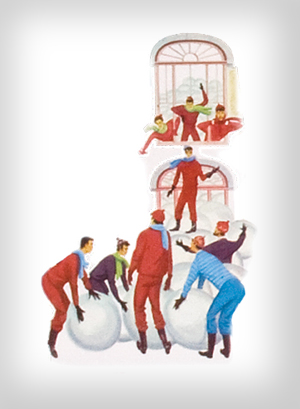
The students at Miami were frustrated with McMaster's attitude, and a tipping point was reached. On January 12, 1848, a large snowfall struck the campus. A few members of the two fraternities saw a chance to make a statement. In the middle of the night, they rolled giant snowballs up to the doors of the primary building on campus – Old Main. The snow and ice acted as a barricade, shutting down the most important building on campus. The janitor arrived that morning to the scene and then contacted McMaster, who was furious. He announced at chapel that morning that every student who was involved would be expelled.

The response from the students was to double-down. More snow arrived and that night the students recruited more of their fraternity brothers to help. The doors weren’t enough for them this time. They packed tremendous amounts of snow and ice in the hallways of the building, bracing their piles with chairs, benches, and wood. The temperature dropped and the snow froze like a block of ice, making the building an unusable mess. The students thought that their numbers would actually work in their favor – that the President couldn’t expel all of them. They were wrong. The university was shut down, trials were held, and after the expulsions, only 68 out of 200 enrolled students remained.

Each time a student was expelled, he would be carried off on the shoulders of his classmates. The students even hired a band to play as their peers cheerfully left the campus.

An enrollment drop of that magnitude did not bode well for McMaster and he was fired by the Trustees shortly after the incident. A new President, Anderson, was hired and he changed the environment to be more welcoming to fraternities. Within a couple of years, enrollment surpassed 200.

Several of the expelled students eventually enrolled at Centre College in Kentucky and formed fraternities there, including the second chapter of Beta Theta Pi. Phi Delta Theta was formed at Miami a year after the rebellion.

The defiance embodied in the snowball rebellion remains in the DNA of fraternities and sororities today. It was one of the earliest markers of our independence as organizations; independence that’s asserted day in and day out on campuses across North America.

The relationship between the college fraternity and the host institution has always been tenuous. Our earliest founders created us because they wanted to provide the human bonds and relationships that colleges at the time purposely tried to avoid. We were seen as a threat because we taught values and debated questions that didn’t fit within the traditional educational environment. We sought to raise the college experience from one that focused only on the stuff of textbooks to one embracing the stuff of life. We wanted colors in our members’ lives other than gray limestone and red bricks.

And we did a really good job of this. So good, that colleges and universities began to embrace what we had to offer (albeit cautiously). More recently, institutions of higher education have lifted the things we were once sole proprietors of – namely relationship building and leadership development – and infused them into other places on campuses. Residence hall learning communities, for example, are direct knock-offs of the original fraternity experience.

However, this doesn’t mean that these institutions embrace Greek-Letter Organizations. In many cases, they may be purposely giving students a more appetizing alternative to fraternities and sororities – signaling the continuation of distrust that institutions have held for them since the days of giant snowballs.

Because defiance is such a part of who we are as fraternities and sororities, I wonder if we can ever avoid it. Even the fraternity or sorority that walks the line most closely on a given campus has the itch to step off every once in a while.

College and university administrators, especially those that do not work directly with Greek-letter organizations, get so frustrated by this. Why wouldn’t they? We can be loud and contentious. We don’t like new rules, and will speak out against them. We like our independence, and sometimes seem to live in our own universe. We still act like the groups that meet in a hidden attic somewhere and would rather be left alone.

And that often leaves us at odds. But, could it all be one big misunderstanding?

To understand us, one needs to know our history. Every defining moment in the fraternity and sorority movement is marked by defiance. Let’s not forget that women’s fraternities and multicultural Greek organizations were also developed in defiance of the status quo. We have always been an outlier because we needed to be.

Now – this is not to say that rules and policies are not important. Even wrongheaded policies are created in order to protect someone – an individual or an organization. Many of our risk management policies, for example, are cumbersome and annoying, but almost all can be justified. The defiance in our DNA does not give us a license to simply break the rules because we feel like it. It may lead us to challenge them more than other groups, however. It’s rare that a new policy isn’t met with some debate by Greek-Letter Organizations, and that’s a good thing. Leave the blind unquestioning adherence to someone else.

So what’s the point of all this? It helps to remember how rebellion and defiance have shaped us. And, it can be a big part of our future. There may be fewer places in the world where taking a stand and showing conviction are rewarded, but at least we can still strive to be one.

In addition, will the problems in our world more likely be solved by rule-following conformists or restless disruptors?

Perhaps it’s time to stop fighting against this inherent rebelliousness in fraternities and sororities, and embrace it instead. How can it help our organizations and the host institutions alike?

I like to keep these posts somewhat short, and so I’ll follow-up with my thoughts on how we can better celebrate and utilize defiance in next week’s entry. For now, please offer your thoughts and ideas. Should we welcome and embrace rebellion in Greek-letter organizations? How do we manage rebellion that’s positive versus defiance that’s dangerous? More to come...


Special thanks to Dr. Phillip Shriver, Historian and President Emeritus at Miami University, who wrote and taught about the Great Snowball Rebellion. You can read more here.

Thanks for a Great Year!

As we close out 2010, I want to thank you for reading and sharing my blog.  This is a labor of love for me, and it has been fun to share my thoughts and engage with you.  I truly understand my position as an observer, commentator, and (sometimes) a critic.  I am not on the front lines in fraternity/sorority life anymore, and so I take my own thoughts with a grain of salt.  It's certainly much easier to try and be provocative from my position, whereas most of you live the realities of the fraternal experience daily.

In other words, I have tremendous respect for you.  I hope that the opinions expressed on this blog can be a contribution to the movement, but I know that the real difference-makers are the students, advisors, and professionals working hands-on every day.  I am thankful that you are there.

Have a wonderful holiday season.  Let's all make 2011 the best year yet for fraternities and sororities!